The Rubik’s Cube is a 3D combination puzzle invented in 1974 by Hungarian sculptor and professor of architecture Ernő Rubik. Originally called the Magic Cube the puzzle was licensed by Rubik to be sold by Pentangle Puzzles in the UK in 1978.
Why was the cube made?
Although it is widely reported that the Cube was built as a teaching tool to help his students understand 3D objects, his actual purpose was solving the structural problem of moving the parts independently without the entire mechanism falling apart. Rubik himself later acknowledged that he purposefully set out to design a puzzle based on geometry. The 27 tiny cubes called “cubies” produced a truly challenging puzzle.
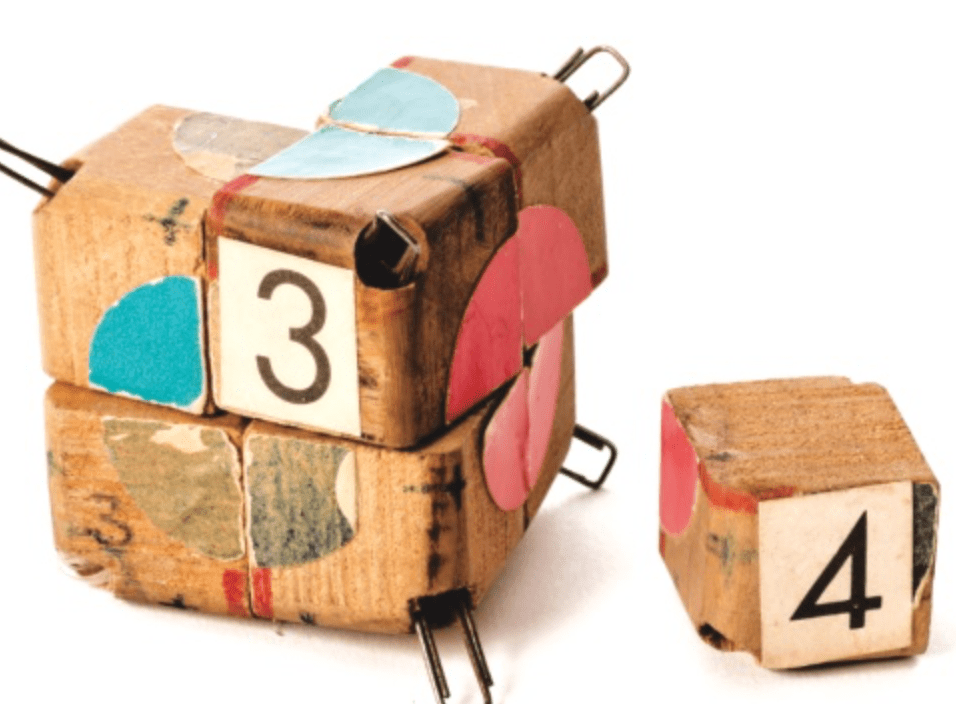
The first Rubik’s Cube Prototype – The invention of Erno Rubik
The patent for this original 2×2 cube was filed in 1972, two years before Rubik invented his own 3×3. These prototypes have only shown how a 2×2 puzzle could be constructed which, although still technically achieving Rubik’s goal, still didn’t quite allow all the pieces to move independently.
On the original classic Rubik’s Cube, each of the six faces was covered by nine stickers, each of one of six solid colours: white, red, blue, orange, green, and yellow. Some later versions of the cube have been updated to use coloured plastic panels instead, which prevents peeling and fading.[15] Since 1988, the arrangement of colours has been standardised with white opposite yellow, blue opposite green, and orange opposite red, and the red, white, and blue arranged clockwise in that order.[16] On early cubes, the position of the colours varied from cube to cube.[17]
Although the Rubik’s Cube reached its height of mainstream popularity in the 1980s, it is still widely known and used. Many speedcubers continue to practice it and similar puzzles, and compete for the fastest times in various categories. Since 2003, the World Cube Association (WCA), the international governing body of the Rubik’s Cube, has organised competitions worldwide and recognises world records.

– World Cube Association
 EverythingCube.UK